

Runar Bäckström Foundation
In support of innovations
The Runar Bäckström Foundation supports inventions that enhance the competitiveness and internationalization of Finnish companies. The foundation grants annual scholarships to individuals, teams, companies, and associations.
Runar Bäckström Foundation
In support of innovations
The Runar Bäckström Foundation supports inventions that enhance the competitiveness and internationalization of Finnish companies. The foundation grants annual scholarships to individuals, teams, companies, and associations.
- The application period is annually from approximately October 1 to December 13.
- The application period is annually from approximately October 1 to December 13
Apply for a grant online
The application period is open from October 1, 2025, and ends on December 13, 2025.
Runar Bäckström
About us
The purpose of the Runar Bäckström Foundation is to encourage and promote inventive activities that benefit Finnish companies and thus strengthen their international competitiveness. The foundation distributes its grants once a year. Grants can be awarded to individuals, teams, companies, and communities. Grant recipients are not required to have formal qualifications, such as a specific academic degree.
Runar Bäckström – an influencer in invention and military economy
Runar Bäckström (September 4, 1902, Kotka – June 2, 1991, Munich) was a Finnish civil engineer, engineer colonel, and director of war economy, who left a significant mark on Finnish industry and invention activities.
He graduated as a civil engineer in 1924 and furthered his education abroad in the United States (1927–1929) and in England and France (1930–1933). Early in his career, he worked as a technical director and representative for various companies, such as Keskuslaboratorio Oy, Central Paper Mill Co. in Michigan, and the Fredriksberg sulfite pulp mill in Sweden.
Bäckström served as the Director of War Economy for Finland from 1940 to 1945, overseeing resource management during the war, and he was granted the rank of engineer colonel in 1941. After the war, he led companies like Kristiinan Puu Oy (1945–1952) and Oy Exim Ab (1945–1974), focusing on the export of the forestry industry.
Additionally, he served as the chairman of the boards for Asfalttibetoni Oy and Kivi-Simo Oy. He was an honorary member of the War Economy Society and moved to Munich in 1974, where he lived until his death.
His contributions to the war economy, industry, and the advancement of innovations are significant, and the foundation he established, the Runar Bäckström Foundation, continues to support the development and competitiveness of Finnish inventions.
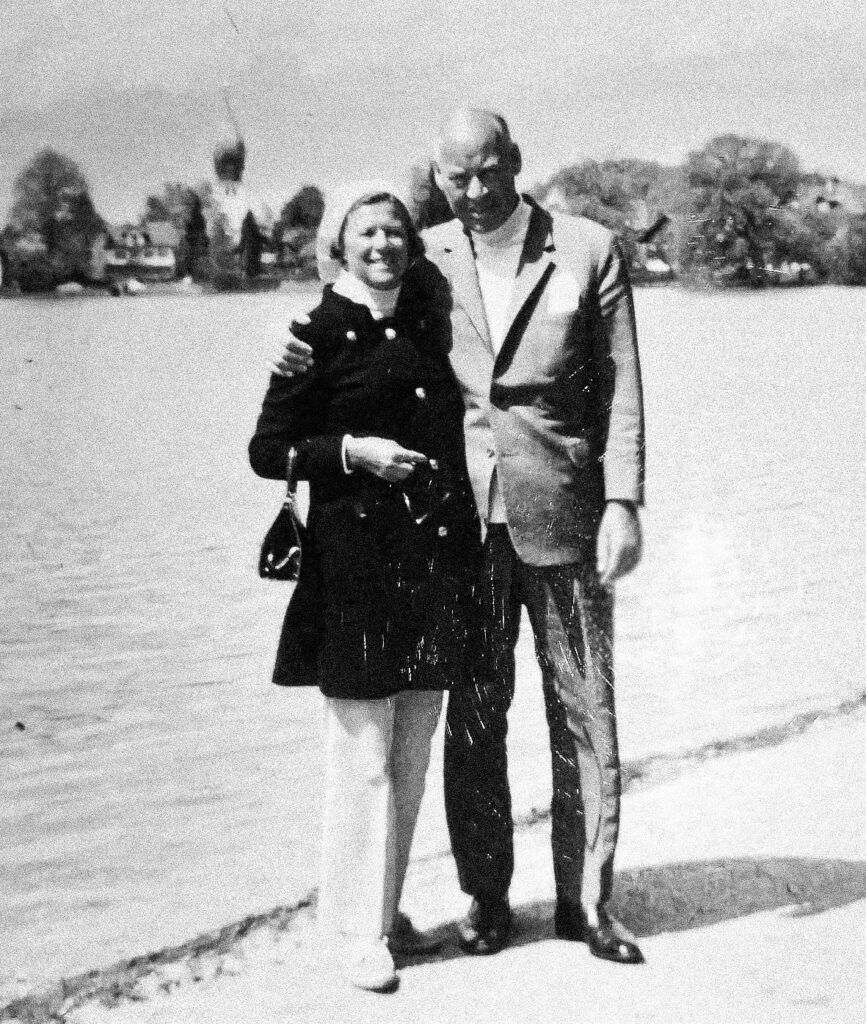
In the picture, Runar Bäckström with his wife Anne-Lise (Mady). They married in 1967 and lived most of their life together in Munich. (photographer unknown)
Applying for a grant
Foundation grants can be applied for during the application period using an electronic application form. Applications are evaluated based on the following criteria:
01
The invention supports Finnish industry.
The definition of industry applies if the inventor has their own company or is in the process of founding one. The funding aims to ensure that the inventor has the opportunity to focus on the commercialization of the idea and assist with the inventor’s salary expenses.
02
The idea works in practice.
The new invention is not too abstract, and its functionality can be verified. It is also considered a merit if the applicant can present the idea clearly. It is possible to attach material to the application that helps in understanding the invention. However, at the application stage, the invention should not yet have any existing revenue.
03
Commercial potential
The invention can be commercialized within a few years. The foundation can support an invention that meets the criteria for several years.
When evaluating grant applications, the foundation’s board may, at its discretion, consult external experts. Grant applications are handled confidentially. Before the grant award ceremony, arrangements regarding the announcement will be made with the grant recipients. Decisions on granting the grants are final. The grant recipient must, upon request, provide a report on the use of the awarded funds and the progress of the development program. If the development program changes significantly, the grant recipient must return the grant to the Runar Bäckström Foundation.
The 2025 Grant Winners
Finlandia Automation
Cable A
Read more
The invention is a cable reel stand.
The invention differs from those available on the market in that it is extremely simple, utilizes the reel itself as a wheel, and is manufactured entirely without moving parts. The stand is bent into shape from a single standard (3m) steel pipe, resulting in zero material waste in the frame. Brackets are welded to the bends, so no measurements or fixings are needed during manufacturing, and the length of the brackets is designed to ensure zero waste from the 3m pipe. Unlike competitors, the stand eliminates the need to carry reels, as they can be pulled along, improving ergonomics.
Finncure Oy
Development of platform-type particle solutions against various diseases.
Read more
FinnCure Oy, in collaboration with the University of Helsinki and University Medical Center Groningen, is developing inhalable solutions based on virus-like micro- and nanoscale particles.
These solutions can effectively prevent various viruses, such as COVID-19 and H5N1, from entering the human and animal body.
The entry of viruses into cells can be blocked by using particles to inhibit receptors in the respiratory system.
At the same time, the immune system can be stimulated using vaccine-like mechanisms.
Our developed synthetic particles can be used as carriers for drugs or, for example, zinc acetate, which is known for its antiviral properties. It has been shown to inhibit the replication of COVID-19 and influenza viruses and alleviate their symptoms.
By combining different properties into the particles, an environment unfavorable to viral replication can be created, thereby strengthening defense mechanisms.
The purpose of this project is to develop particle-based solutions that can serve as both a blocking and immune-stimulating solution for various viral infections, such as H5N1. This can significantly reduce the risk of respiratory infections, enabling the human immune system to function more effectively. This prevents the spread of viral diseases and reduces societal burden.The requested 15,000 euros, in addition to our own funds, will be used to develop our particles so that they can be tested on genetically modified mice, allowing us to proceed with testing the solutions in humans.
Kaivotohtori Oy
Biowater filter and water indicator concept.
Read more
A water filter and water indicator concept designed for widespread use to improve:
1) Water hygiene
2) Water safety
3) Removal of microplastics from water
4) Filtration of runoff and stormwater in agricultural and forestry headwaters
5) Biological filtration of wastewater
Korpi Topias
A refrigerant-free heat pump.
Read more
The invention is a novel heat pump based on an alternative operating principle compared to existing heat pumps. It also addresses significant issues that have previously hindered the widespread adoption of heat pumps operating on a similar principle.
The invention solves two major problems associated with currently used heat pumps: the use of refrigerants and low efficiency.
Since the operation of current devices relies on the phase change of refrigerants at different stages of the process, the refrigerant’s evaporation point and critical point set a physical limit on the heat pump’s operating temperature range. Outside this range, the heat pump no longer functions as intended. Additionally, refrigerants are problematic due to their environmental impacts (ozone depletion, greenhouse gas emissions, flammability, and toxicity). The invention operates on a different thermodynamic cycle that does not use refrigerants at all, thus completely resolving these issues.
Although current heat pumps perform well in many applications, their efficiency is not particularly high, typically ranging from about 40–60%. The efficiency of heat pumps is often described by the coefficient of performance (COP), which is the heat transferred by the heat pump divided by the energy it consumes. Efficiency reflects the difference between the actual COP and the theoretical maximum COP for a given temperature difference between the cold and hot sides of the heat pump. Improving efficiency increases the COP, which in turn means lower energy consumption and thus lower costs for transferring the same amount of heat. The operating principle of the invention enables significantly higher efficiency compared to current devices.
This invention, which addresses these problems, can open entirely new applications for heat pumps and significantly reduce energy consumption in existing applications. In current applications, the potential for energy savings also translates into significant cost savings. In new applications, heat pumps could potentially replace a substantial amount of fossil fuel use, thereby reducing emissions.
Lignum Medical Oy
Development of a device for the treatment of female urinary incontinence.
Read more
Over half of women experience urinary incontinence at some point in their lives, and the prevalence of this condition increases with aging populations. It is estimated that the market for surgical treatment of female urinary incontinence is currently around $1.3 billion annually, growing significantly due to factors such as population aging, and is projected to reach approximately $2 billion by 2027.
Lignum Medical is developing a treatment option for stress urinary incontinence (SUI) in women. Our patented technology is based on extensive preclinical trials demonstrating the potential of a safe, plastic-free, and environmentally friendly nanocellulose hydrogel for SUI treatment. This treatment requires a specialized applicator device, which enables the surgeon to perform the procedure under visual control.We are developing a Class III medical device for international markets, seeking both FDA and CE approval before 2030. Our mission is to develop innovative and sustainable treatment options for stress urinary incontinence, a growing medical issue in aging populations.Our goal is to improve women’s health and quality of life globally while considering sustainable development.
Nutakor Charles
REAL Machine, a high performance traction electric motor WITHOUT magnets
Read more
The REAL Machine is an innovative electric motor technology that operates without magnets. It is designed to
provide exceptional performance for electric vehicles (EVs) and various electrification applications.
By eliminating the dependence on rare earth magnets, this motor helps mitigate geopolitical and supply chain
risks while offering a sustainable and highly efficient solution for the electrification industry.
The Problem It Solves:
Our invention addresses a critical challenge in the electrification industry: the heavy reliance on rare earth
magnets for electric motors. This dependence creates supply chain vulnerabilities, geopolitical risks, and price
volatility. With the rapid growth of electrification, especially in electric vehicles (EVs), there is a significant risk
of supply disruptions and rising costs due to China’s control over 90% of the global rare earth magnet supply.
Moreover, existing magnet-free motor technologies do not match the performance and efficiency of magnetbased solutions.
What It Replaces:
The REAL Machine provides a sustainable and high-performance alternative to permanent magnet motors,
which account for over 85% of the electric vehicle (EV) market. It also surpasses the conventional option,
synchronous reluctance motors (SynRMs), by addressing their shortcomings in torque, power factor, and highspeed reliability. By eliminating the reliance on rare earth magnets, our invention offers a scalable and costeffective solution for various industries, including EVs, wind turbines, and industrial machinery.
Competitors:
The primary competitors are existing motor technologies, including:
Permanent Magnet Motors (PMMs): While highly efficient, PMMs depend on rare earth magnets, making them
susceptible to supply chain risks and high costs.
Conventional Synchronous Reluctance Motors (SynRMs): These motors are magnet-free but are limited by
lower performance, especially in high-power and high-speed applications.
Compared to these alternatives, our technology offers:
– No reliance on rare earth magnets, ensuring supply chain stability and cost-effectiveness.
– Superior performance, with up to 25% better energy efficiency and torque than conventional SynRMs.
– Superior performance, with up to 25% better energy efficiency and torque than conventional SynRMs.
– High-speed reliability, achieved through our innovative rotor design, eliminates structural weaknesses in other
technologies.
By addressing the core limitations of both PMMs and SynRMs, our invention positions itself as a
groundbreaking solution to support the growing demands of electrification.
NW Systems Ab Oy
Greenhouse dehumidification by combining condensation and adsorption technologies
Read more
• The invention is based on the use of two types of heat exchangers to remove moisture from greenhouses in an energy-efficient manner without venting out added carbon dioxide (CO2). (The normal CO2 level in greenhouses is approximately 1000 ppm.)
• Compressor-based dehumidification systems on the market remove about 4 kg of water per 1 kWh of electricity.
• This system removes an average of about 14 kg of water per 1 kWh of electricity.
• This invention reduces the energy requirement for humidity control in greenhouses by 60–90% compared to traditional ventilation through roof vents, depending on outdoor and greenhouse temperatures and humidity levels. This results in an overall heating energy saving of 20–50% annually, depending on the greenhouse type, lighting amount, crop, etc.
• The first heat exchanger condenses water from the greenhouse air stream while simultaneously heating the outdoor air stream.
• The heated outdoor air and cooled greenhouse air are passed through a second absorbing rotary heat exchanger, which reheats the greenhouse air while removing additional moisture from the greenhouse air through its absorbing function.
• Patent applications were filed in 2023.
Ruotsalainen Teemu
Dry electrode technology for measuring biopotential signals such as EKG, EOG, ECG, EMG, EEG.
Read more
VTT’s Mukava team has developed a dry electrode technology that addresses the widespread issues of gel electrodes, which are considered the “gold standard” and dominate the electrode market. Although gel electrodes are almost exclusively used in biopotential measurements such as EKG, EOG, ECG, EMG, and EEG, they have significant problems related to signal quality, skin irritation, and user comfort.
These issues are global and substantial in scale. For example, in the USA, approximately 10-20% of cardiology patients receive an incorrect diagnosis due to inaccuracies in EKG measurements [Source: National Academy of Medicine – Report on Diagnostic Errors]. Similarly, in the USA, $750 billion is spent annually on incorrect and unnecessary treatments, a significant portion of which stems from misdiagnoses, with root causes including inaccurate or poor-quality biopotential measurements [Source: McKinsey & Company – The Unseen Impact of Misdiagnosis].
Skin irritation caused by gel electrodes is also relatively common. The prevalence of skin irritation varies across studies, but it has been observed that up to 60% of users may experience skin irritation during measurements [Source: Lensu, M. 2015 Thesis, JAMK University of Applied Sciences, Wellbeing Technology Program].
Uniki Oy
Composite paper and paper making process
Read more
The invention relates to replacing plastics with a bio-based material. The invention is a composite paper product and its associated manufacturing method.
The challenges with currently used plastic films include issues with biodegradability and carbon dioxide emissions. The reasons why paper-based products have not yet replaced plastic films are likely related to their inferior dry strength, wet strength, thickness, weight, and elasticity properties compared to plastic packaging materials.
This composite paper product invention aims to improve these properties, making the production of paper- and cardboard-based packaging materials competitive with plastics.
The invention is a composite paper product for packaging, as a protective layer for materials, and for serving food and beverage products. In addition to wood fibers, the invention utilizes a polymer combination that is bio-based, biodegradable, and recyclable along with paper. The desired impact of the invention can be achieved because the quantity, type, and application method of bio-based polymers in paper production are novel.
Xfold Imaging Oy
Cost-effective and high-sensitivity Xfold biosensor for point of care molecular diagnostic devices for Infectious diseases
Read more
Medical diagnostic methods encompass a wide range of techniques and technologies such as (1) medical imaging (2) microscopic examination of clinical specimens (3) culture and detection of organisms (4) immunoassays for the detection of antibodies or antigens in clinical specimens (5) Nuclei acid amplification test (NAAT) for the detection of pathogen-specific DNA/RNA in clinical specimens.
The availability and accessibility of imaging modalities, microscopic examinations, and culture methods are very limited, particularly in
resource-limited settings or rural areas, leading to disparities in diagnostics. Immunoassays (antibody or antigen tests) are widely used in point-of-care (POC) settings due to their simplicity, speed, and ability to detect various biomarkers.
POC immunoassays provide rapid results at the patient’s bedside or in decentralized healthcare settings, allowing for immediate diagnosis, treatment decisions, and monitoring. However, the major challenge of immunoassays exhibits lower sensitivity, specificity, and detection of an analyte in samples with extremely low concentrations. NAATs utilize the principle of amplification of target nucleic acids several million-fold, they are more sensitive compared to the immunoassays. The most commonly used NAAT amplification methods include polymerase chain reaction (PCR), reverse transcription (RT-PCR), Loop-mediated isothermal amplification (LAMP), and strand displacement amplification (SDA PCR or RT-PCR is the gold standard technique (with sensitivity above 90%) for diagnostics, such as for example, infectious diseases.
The nanoplasmonic Xfold biosensor contains advanced nanostructure on the top surface of the polycarbonate sheet. The Xfold nanostructure resonates with the excitation wavelength, significantly increasing the emission intensity of fluorescent dye in the PCR or RT-PCR reaction, thereby enhancing clinical analytical sensitivity compared to existing technologies. In the phase I study (2024), we simulated, fabricated, and tested the Xfold nanoplasmonic microscopy slides with mycobacterium bovis- bacillus Calmette-Guérin (BCG) spiked sputum samples.
The results are very promising, and we plan to present these initial research findings at conferences and meetings. Also, we acknowledged the funding from the Bäckströms grant, in the European union horizon 2020 research and innovation program at NOVA University Lisbon on 9th Oct 2024. In this proposal, we aim to progress to the next phase (Phase II), focusing on Xfold nanoplasmonic biosensor integrated microfluidic plastic chip for cost-effective, high-sensitivity and point of care molecular diagnostic device by using largescale manufacturing technology of roll-to-roll (R2R) nanoimprinting. Furthermore, we plan to conduct sensitivity, Limit of Detection (LoD), studies for infectious diseases including influenza.
Providemus Oy
Virtual Rolling Mill
In addition, a grant was awarded separately for the following project:
Kemistklubben vid Åbo Akademi rf – Axelborg IV – 15,000 EUR
Frequently Asked Questions
1. When does the application period open?
Usually from October 1st to mid-December.
2. What can the grants be used for?
The grants can be used freely as long as the use is for advancing the invention.
3. Can an individual apply for a grant?
Yes.
4. Can a foreigner apply for a grant?
Yes, as long as there is, for example, a company in Finland.
5. Are the applications processed confidentially?
Yes, absolutely confidentially, and under no circumstances will anything be published, meaning the patentability will not be affected even if applying for a grant.
Press releases