In 2022, the Runar Bäckström Foundation granted funding for Åbo Akademi’s project “Passive Cooling Roof Window Prototype.” The goal of the project is to develop Prototype II, which functions effectively during the day as well. The first proof-of-concept prototype (Prototype I) demonstrated passive cooling powers of 100-150 W/m² during the night. Gopala Gangisetty’s doctoral work (2021-2025) aims to achieve similar cooling powers during the day, when solar radiation of several hundred W/m² makes passive cooling significantly more challenging.
To address this, the use of nanoparticles (NP, nanoparticles) is being investigated – specifically, SiO₂/TiO₂ combinations – which selectively block (by reflecting, absorbing, or re-emitting) part of the solar radiation. The roof window is designed to let natural light in during the day while also cooling the building.
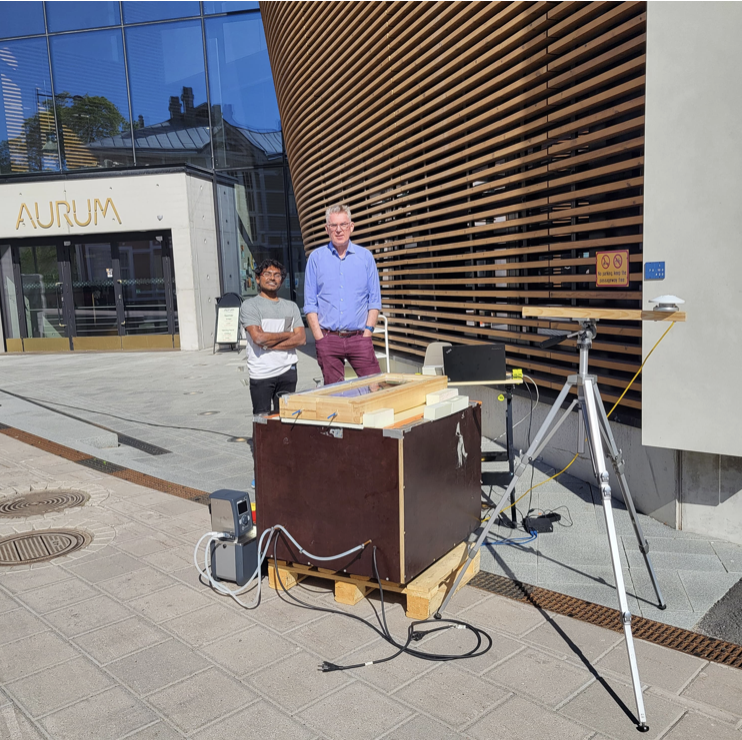
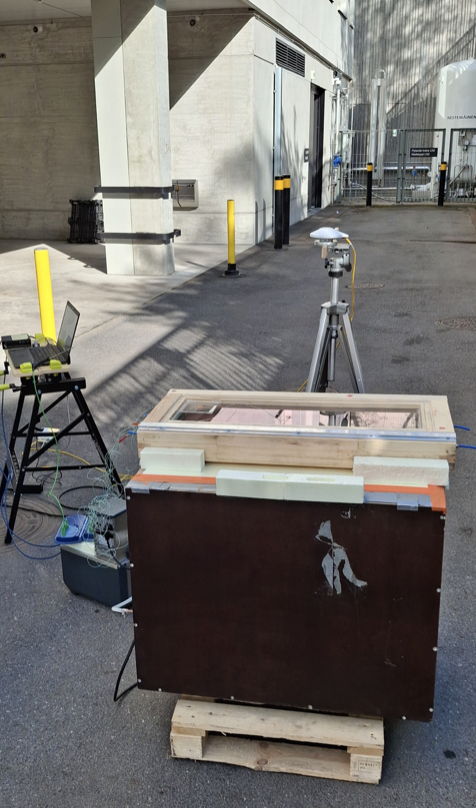
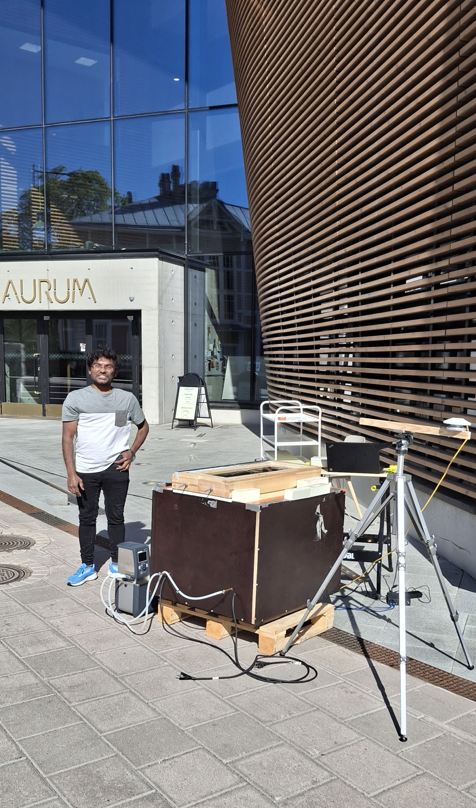
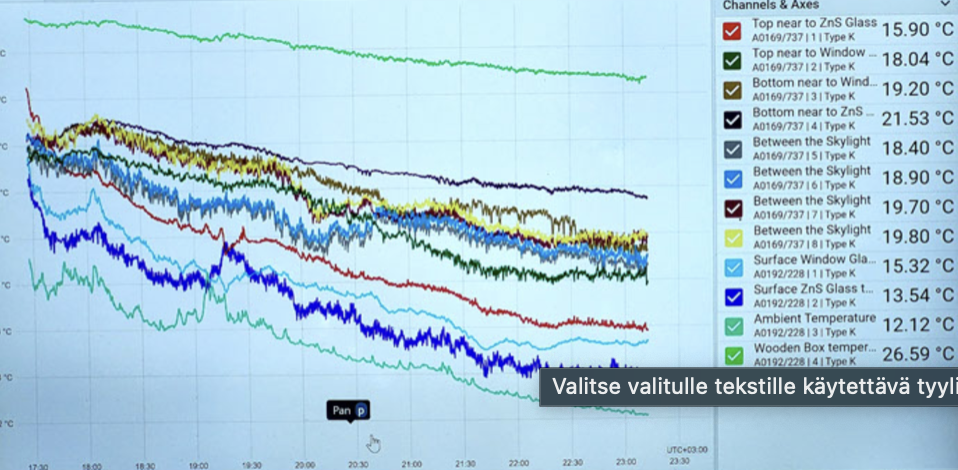
After testing several different nanoparticle formulations, along with miniature model experiments conducted in laboratory conditions, outdoor testing has now begun. Prototype II, measuring 90 cm x 30 cm x 10 cm, has been placed outside the Åbo Akademi (ÅA) Aurum building, and the tests will continue until August. Of particular interest is the performance during sunset and sunrise, when short-wave (SW) radiation is emphasized.
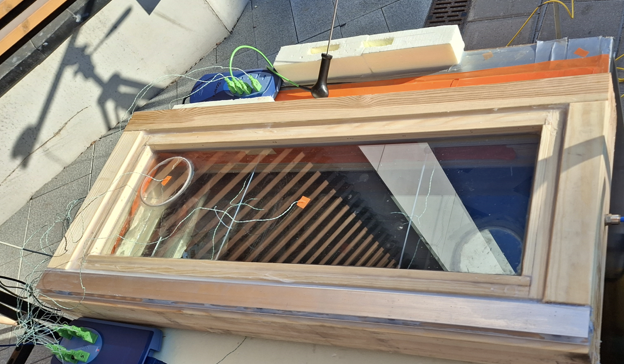
The tests are being conducted using round (see image, nanoparticles have not yet been added) or square-shaped special glass panels, which allow long-wave (LW) thermal radiation to pass through. These glasses are embedded into standard window panes that do not allow long-wave radiation to pass through. Additionally, different gases, such as air, carbon dioxide, or an air-ammonia mixture, are used inside the roof window. The temperature of the sky – to which the heat is radiated for passive cooling – is measured using a pyrgeometer that covers the long-wave range.